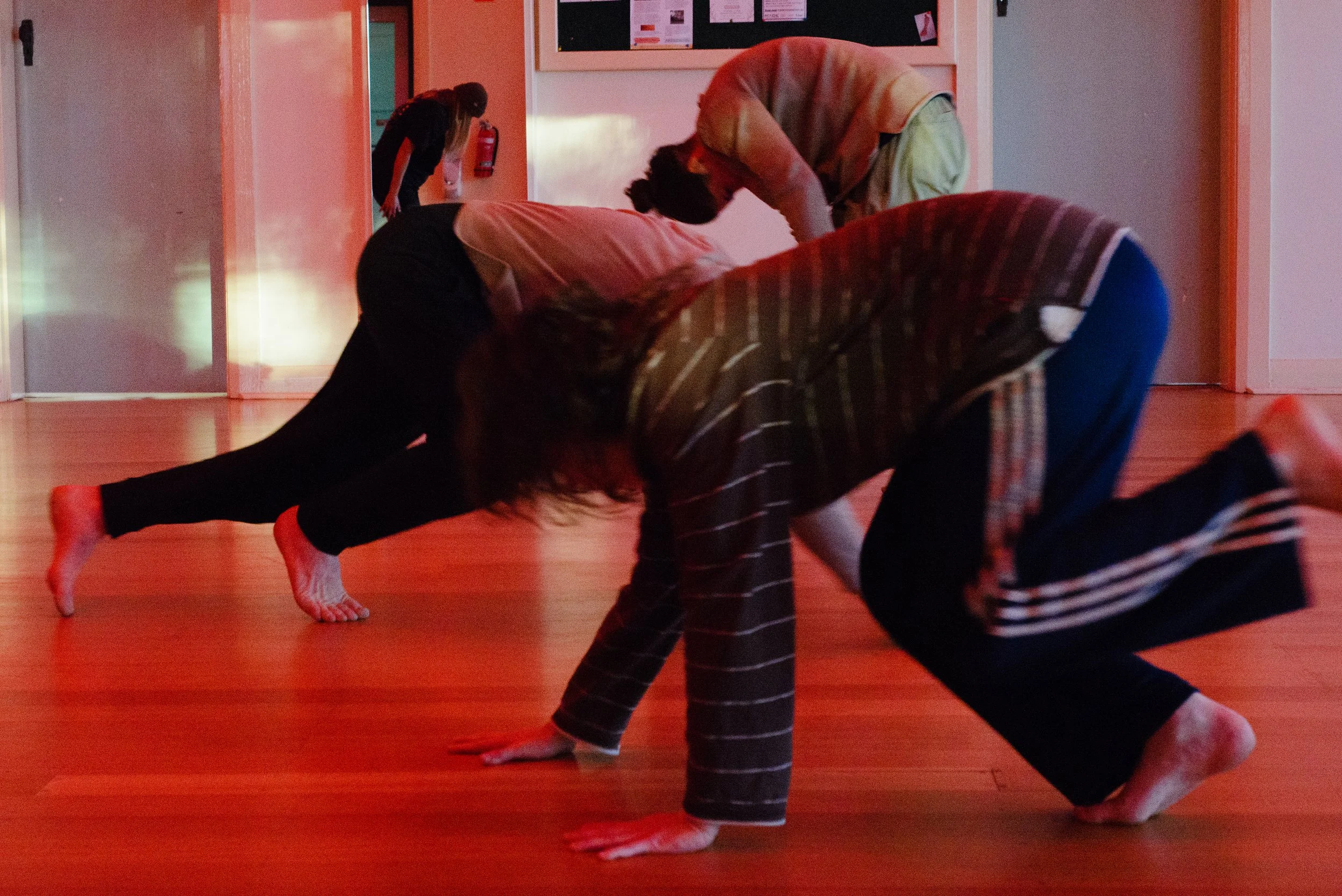
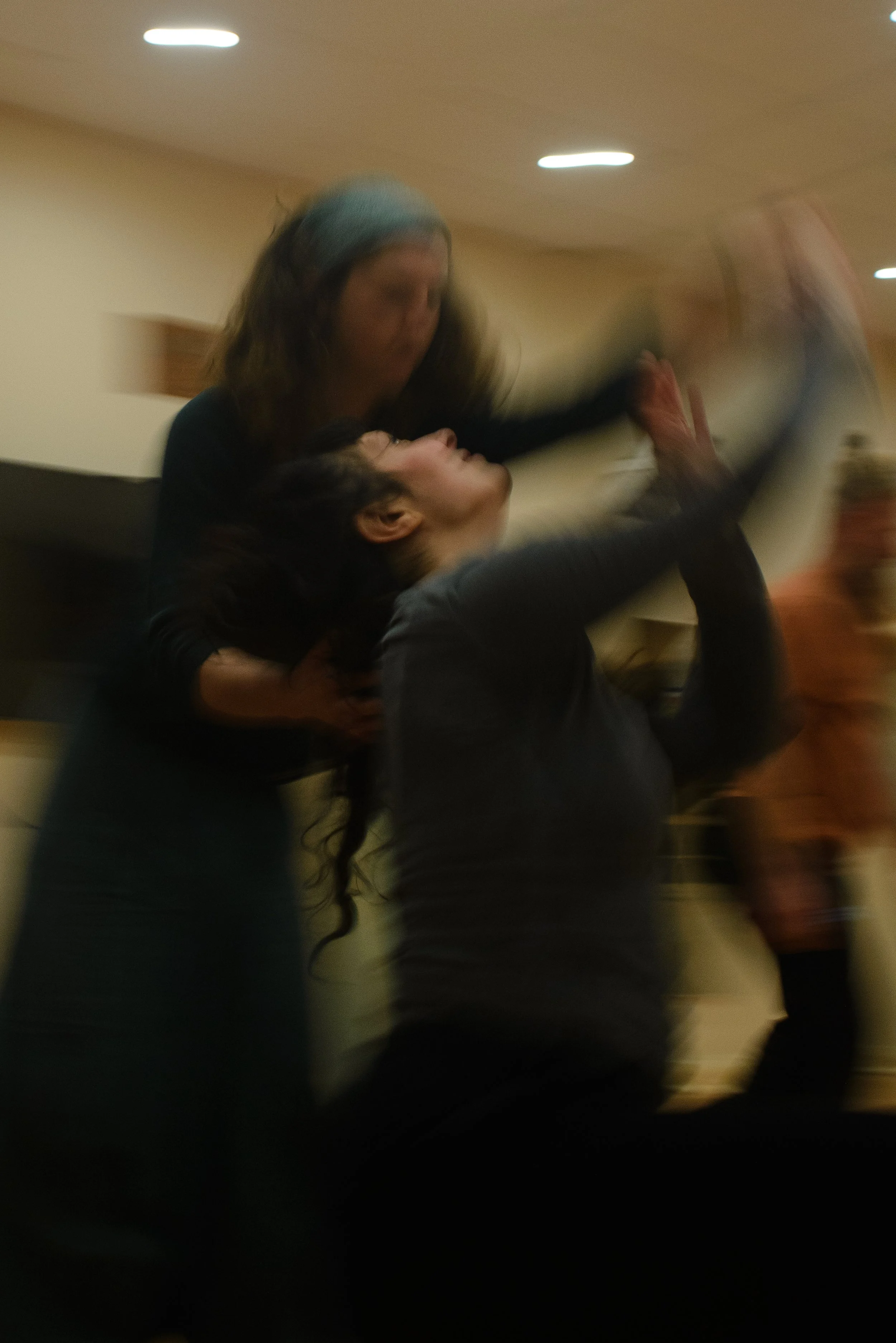
Contact Improvisation
What is Contact Improvisation?
Contact Improvisation is an act of listening with the body.
Through the senses, and with radical presence, we invite movement, play, and interaction with ourselves, other people, and the space around us. It is a practice of paying attention — to touch, momentum, gravity, sensation, and response — allowing movement to emerge through curiosity rather than choreography.
Foundational aspects of Contact Improvisation call you back to your body’s innate wisdom, exploring the physical principles of touch, shared weight, momentum, support, and responsiveness. It offers practical tools for moving with greater awareness, adaptability, and trust — both with yourself and with others.
At its core, Contact Improvisation is a deeply communicative and community-driven movement practice. It returns us to a shared point of contact, offering endless possibilities for movement exploration, creative play, and embodied connection.
Who Can Join?
Contact Improvisation is open to all human beings, from every walk of life.
This practice welcomes anyone with an interest in movement, curiosity, and embodied exploration — no matter your background, experience, or discipline. Whether you are a dancer, mover, artist, athlete, complete beginner, or simply curious, there is space for you here.
Contact Improvisation may be especially resonant for those interested in:
moving more freely beyond the confines of choreography
developing trust in improvisation
exploring touch, momentum, gravity, and weight-sharing
deepening body awareness and responsiveness
finding new ways to move, listen, and play
No prior experience is necessary. Curiosity is enough.
What We Practice
Within Contact Improvisation, we often explore:
Point of Contact — the shared physical point that guides communication and movement
Rolling Point of Contact — allowing the point of connection to move continuously through space
Weight Sharing — giving and receiving weight with clarity, timing, and support
Momentum & Inertia — working with energy, gravity, and the natural flow of movement
Small Dance — tuning into subtle internal shifts, balance, and responsiveness
Flow & Grounding — finding ease, stability, and adaptability in motion
These principles offer practical tools for movement exploration, improvisation, and deeper physical listening.

The Facilitator
Brianna Shahin is an Egyptian–Australian movement artist, facilitator and bodyworker based in nipaluna/Hobart, lutruwita/Tasmania.
Her practice is grounded in curiosity, physical listening, and the ways bodies communicate through touch, weight, momentum and responsiveness. Drawing from contemporary dance, improvisation, Judo, Brazilian Jiu Jitsu and bodywork, Brianna works across movement practices that support greater awareness, adaptability, trust and connection.
Her teaching is shaped by a strong interest in relational movement — how we support ourselves, meet others, negotiate space, and move with more clarity and choice. She facilitates with an emphasis on consent, curiosity, play, and creating spaces where people can learn through direct experience at their own pace.
Brianna has taught across dance, youth, community and interdisciplinary settings, and is passionate about making movement practices more accessible, grounded and welcoming to people from all backgrounds and levels of experience.
Background Images by Tom Wakefield
Personal Image by Millie Richards <3
Middle Ground is an ongoing Contact Improvisation platform — a shared meeting point for movement, attention, and exchange.
It is a space for gathering, listening, and negotiating what becomes possible when we meet in motion. A connector, organiser, instigator, and container, Middle Ground brings people together through touch, movement, and shared decision-making — making visible the subtle ways we listen, respond, support, and adapt in relation to one another.
Each session is shaped in real time by the people in the room. It is built collectively through presence, experience, instinct, and the shifting intelligence each person brings to the space that day, hour, moment, and second.
Drawing from Brianna’s experience in contemporary dance, martial arts, and relational movement practices, Middle Ground offers a grounded and responsive container for community dance, physical dialogue, and shared exploration.
Middle Ground runs weekly on Sundays at Mount Stuart Memorial Hall (14 Byard St, Mount Stuart TAS 7000), 4 PM - 6 PM
Each session is split into two parts: the first half offers guided tools, principles, and movement investigations; the second half opens into supported integration, giving space to explore, practise, and apply what has been introduced.
$20 per person. All levels welcome. More info on Instagram: @crockpot_g and on the Facebook group: Contact Improvisation Tasmania.
CI Core Principles
Consent is foundational to this practice.
You can say no, pause, change your mind, or step away at any time. Participation is always optional, and observation is just as valid as physical engagement.
A “yes” to dancing is not a “yes” to everything. Consent is ongoing, active, and can be withdrawn at any point.
Consent, consent, consent…
Take Responsibility for Yourself
Move within your own limits.
This practice invites you to listen closely to your body, notice your boundaries, and make choices that support your safety and wellbeing. Take your time. Move at your own pace. Rest when needed.
You are responsible for how you enter and engage with the space, and how you care for yourself within the practice.
Listening is central.
We listen with the ears, the eyes, the skin, and the body. We listen to ourselves, to one another, and to the space around us.
Your voice is part of the practice too. If something feels unclear, uncomfortable, or off, say no, speak up, or talk to the facilitator. Clear communication supports safer and more connected practice.
Listen, and speak up
-
Contact Improvisation is a non-sexual movement practice.
Touch is used as a tool for listening, communication, and movement exploration — not for sexual or romantic pursuit. Sexualised behaviour, coercion, or boundary-pushing is not welcome in this space.
This boundary is non-negotiable.
-
You do not need to stay in a dance once it no longer feels right for you.
You can pause, step away, or end an interaction at any time without explanation. Respecting this is part of the practice.
-
“No” is a complete sentence.
If someone sets a boundary — verbally or non-verbally — it is to be respected immediately, without question, persuasion, or negotiation.
Safety, Care, and Shared Responsibility
Contact Improvisation is built on shared responsibility.
While each person is responsible for their own body, we also practice care for the people we move with. This means staying attentive, responsive, and aware of how your choices affect others in the space.
Move with Care
Be mindful of your own safety and the safety of others.
Do not force weight, speed, or intensity. Shared weight is a conversation, not a demand. Offer support with clarity, and receive with attention.
Slow Down
Slowing down increases safety, awareness, and choice.
If you feel overwhelmed, uncertain, or overstimulated, reduce speed and return to sensation. Slowing down creates more space to listen and respond.
Use Your Words When Needed
Words are welcome when clarity is needed.
You can say:
stop
wait
slower
no
I need to pause
Verbal communication is encouraged when it supports safety, consent, and clarity.
Rest with Awareness
Rest is welcome. Observation is welcome.
If you are pausing or sitting out, move to the edge of the space so the dance floor remains clear and active for others.
Space Etiquette
Enter with Awareness
Approach others with care and clarity.
Do not abruptly initiate contact, especially from behind or outside someone’s field of awareness. Make space for mutual recognition and consent before entering a dance.
Keep Verbal Communication Minimal
This practice prioritises body-based listening.
Conversation is welcome before and after class, but during practice, keep verbal communication minimal unless it is needed for safety, consent, or clarity.
Dress for Movement
Wear comfortable clothing that allows you to move freely.
Clothing that covers knees and elbows is recommended to support sliding, reduce friction, and protect the skin.
Please avoid:
exposed zippers or sharp fastenings
large jewellery
anything that may scratch, catch, or injure
Hygiene Matters
Please arrive clean and practice good hygiene.
To support comfort and accessibility for everyone:
avoid strong perfumes, oils, or scented products
keep fingernails short
cover cuts, wounds, or anything contagious
wear clean clothes suitable for shared physical practice
This is a shared physical space. Care for it accordingly.